















 My name is Dr. Julia Petty, and I am a nurse lecturer specialising in children’s nursing with a particular interest in neonatal care. My nursing career in paediatric and neonatal clinical nursing practice began after a BSc Hons degree in Psychology at Warwick University, when I moved to Great Ormond Street Hospital, London. Here, I trained in children’s and adult nursing before working there for many years in children’s and neonatal surgical care. I then gained my neonatal nursing qualification at St George’s NHS Trust London and worked at the Whittington NHS Trust NICU before moving back to Great Ormond Street for a senior education role on NICU where I worked until 2001. I then worked as Senior Lecturer at City University, London for 12 years leading the neonatal nursing education portfolio. I studied for a MSc, a PGCE and MA in academic practice during this time, In 2013, I moved to the University of Hertfordshire where my role is Associate Professor (learning and teaching) and Senior lecturer child nursing. I teach on the BSc Hons nursing and master’s degree programmes including leadership of modules, face-to-face/online teaching, assessing and supervision of students at all levels up to doctorate level. I am also research active and have completed a Doctorate in Education. As a nurse, educator and post-doctorate researcher, my interests focus on parents’ premature birth experiences, supporting parents in the transition home from NICU, exploring communication needs of neonates and their carers and studying the educational value of digital storytelling. This combination and variety of roles enriches my working life and brings together my experience as a child / neonatal nurse, educator and researcher. My role and related activities enable me to engage in both education and research while supporting students on their nursing career and education pathway, which is a privilege to be part of.
Network structures vary around the country, but many employ a Deputy Director or a Senior Lead Nurse. This role acts as a line manager to the wider network team, including QIS nurses, Care Coordinators, AHPs and Education team.
As a senior lead nurse, you would be required to support and manage each team as they navigate their work programme. The role also includes responsibility for leading region-wide projects and linking regional teams with wide regional and national initiatives.
Before you can apply for this role, you will need to gain extensive experience across a number of neonatal nursing roles including management, education, advanced clinical practice. You would also benefit from experience within a network role and being involved in national groups, which provides experience outside of your neonatal unit.
 Hello my name is Claire Richards and I’m the Lead Nurse for the Wales Maternity and Neonatal Strategic Network. This covers nursing leadership but also Neonatal transport. I also have a clinical honorary contract in one Health Board.
 Hello, my name is Kim Edwards, and I am a Neonatal Nurse. I am currently the Lead Nurse and Workforce, Education Lead for the Thames Valley and Wessex Neonatal Operational Delivery Network (ODN)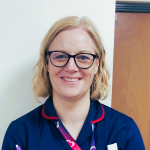
 Hello, my name is Jean and I am a registered children’s nurse with 27 years experience. I qualified with a DipHE after struggling academically due to dyslexia. Over my career I have worked mainly in PICU, NICU and children’s cardiac critical care. I am dual qualified in speciality (QIS) for both Neonatal and Paediatrics. The QIS program is a post graduate modular course completed at level 6/7. To be considered QIS you must successfully complete 4 separate modules, each have an academic and practical component. Only on completion of the QIS course can you apply for a band 6 role. In addition to the above qualifications it is expected you would have several years proven experience in speciality at Band 6 and 7 prior to applying for a Matron’s role.